HDFC Bank: Everything you need to know about HDFC Bank
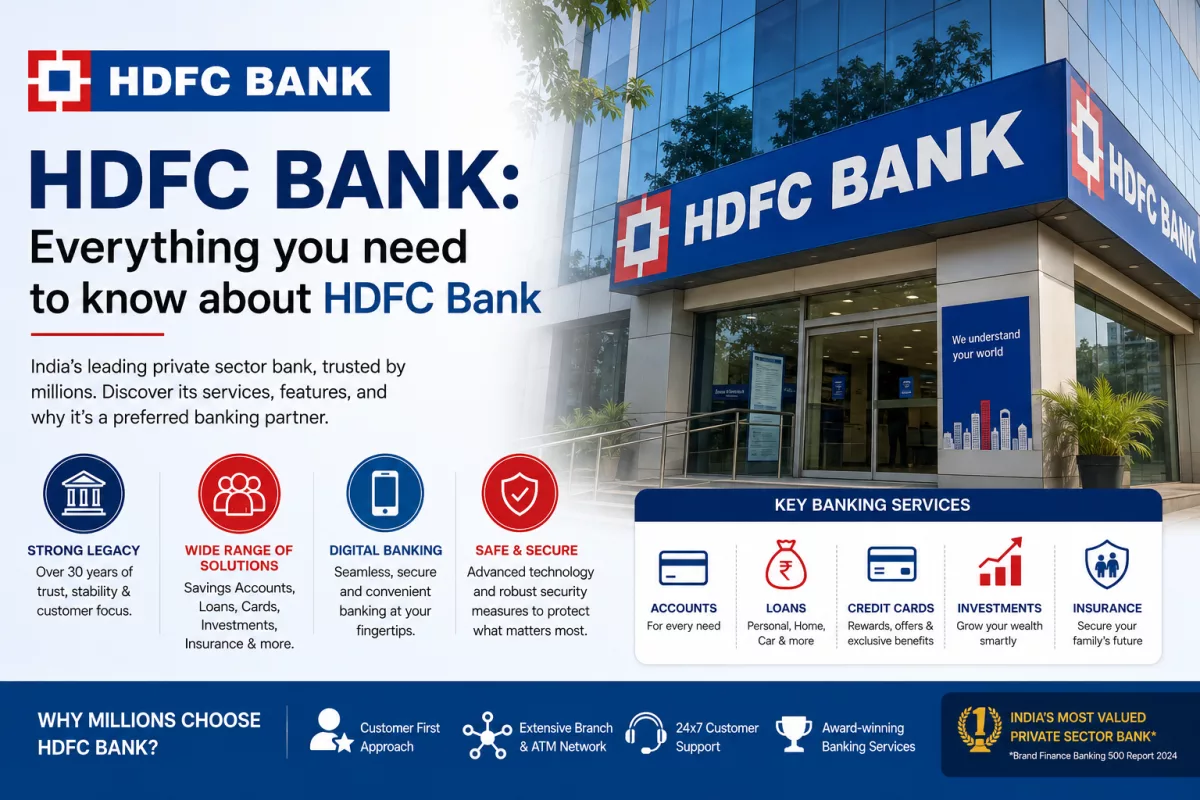
Coming to the major private sector banks operating in India, there is no way one can miss HDFC Bank. The various banking services offered by HDFC include savings account, credit card facility, loans, digital payment system, investment banking services, and business banking services.
But then again, the question arises that what is the HDFC Bank, how it works, what services do HDFC Bank provide, and why is the HDFC Bank so important to the Indian banking industry? In this article, we would discuss HDFC Bank's different dimensions including the history of HDFC Bank, services of HDFC Bank, and many more.
What Is HDFC Bank?
HDFC Bank Limited is among the leading private sector banks in India. It is incorporated in August 1994 and commences operation as a scheduled commercial bank in January 1995. Over time, HDFC Bank has moved beyond conventional banking services to a variety of other financial services. Its customer base includes individuals, professionals, small enterprises, corporates, and organizations.
The services offered by HDFC Bank today range from bank accounts, deposits, loans, credit cards, digital payment, business banking, wealth services, and investment related products.
History of HDFC Bank
History of HDFC Bank is linked to the Housing Development Finance Corporation or HDFC Limited, which was created in India as a leading housing finance company. HDFC Bank was created in the era of liberalization of the Indian banking sector and then grew into a large bank with the customer base and branches. The bank has also grown via some acquisitions throughout its history.
One of the most significant events in the history of the bank was the merger of HDFC Limited with HDFC Bank. The merger was announced in April 2022 and completed in 2023, thus resulting in incorporating India's biggest housing finance company in the banking group.
Mergers of HDFC Bank & HDFC Limited
Mergers of HDFC Bank and HDFC Limited are among the important events in India’s financial industry. Prior to the merger, HDFC Limited operated mainly in housing finance while HDFC Bank operated as a commercial bank. Thus, by combining both companies it became possible to offer customers a bigger range of financial services in one ecosystem.
Post-merger, the HDFC Bank Group also has a substantial presence in sectors like insurance, mutual funds, brokerage, and alternative investments through its subsidiary and allied entities. From the perspective of customers, the merger may help them in accessing diverse financial services while remaining associated with the entire HDFC family.
HDFC Bank Products and Services
One of the reasons for the popularity of HDFC Bank is the diverse array of products offered by the bank to its various categories of customers.
Saving and Current Accounts
HDFC Bank provides various types of accounts, which include saving accounts, salary accounts, current accounts, rural accounts, and special saving products. Various kinds of saving accounts are tailor-made for different customer needs, and these include products for youth, women, senior citizens, and premium customers. The bank also offers online account opening facility to customers. Suitable customers may open their accounts online with the help of video KYC.
Loans
Another vital aspect of the HDFC Bank’s offerings is loans. Subject to eligibility and availability of products, customers can consider financial products like:
- Personal loans
- Home loans
- Vehicle loans
- Business loans
- Consumer finance
- Other credit products
The link between HDFC’s ecosystem and housing finance is of particular importance in light of the recent HDFC Bank-HDFC Limited merger.
Credit Cards
There is one thing that HDFC Bank is known for, and that is credit cards. HDFC Bank has several credit cards that appeal to different types of customers. There are many advantages associated with credit cards that include reward points, discounts, cash back, and more based on the credit card that the customer uses.
Digital Banking
It is no secret that most banks have opted for digital banking today. In other words, digital channels have been established by most banks including HDFC Bank. The bank has the digital platform that includes NetBanking, mobile banking, UPI, WhatsApp Banking, PayZapp, MyCards, and others. Using the digital platform of HDFC Bank, customers can conduct numerous transactions online and save time and effort by not visiting bank branches.
HDFC Bank NetBanking
HDFC Bank NetBanking is one of the most prominent digital channels provided by HDFC Bank. Through NetBanking, users are able to perform tasks such as account management, deposit transactions, card management, bill payments, investments, and others. Furthermore, HDFC Bank also emphasizes the presence of security measures like behavioural biometrics and multi-factor authentication in the digital-banking offering. The presence of online banking allows users to perform transactions through the computer or smartphone as preferred.
HDFC Bank Mobile Banking & Digital Payments
Mobile phones have completely changed user interaction with banks and HDFC Bank has made huge investments in mobile first approach. HDFC Bank provides facilities of mobile banking and digital payments such as UPI. In addition to this, HDFC Bank’s digital ecosystem also consists of PayZapp which is aimed at facilitating online payments and associated financial processes. Moreover, HDFC Bank has also offered WhatsApp Banking to the customers enabling them to avail various facilities.
HDFC Bank Branches and ATM Network
Though digital banking has gained popularity, traditional bank branches continue to matter in India. According to the CSR report of the HDFC Bank for FY2024-25 as on September 30, 2025, the HDFC Bank has a total of 9,545 branches and 21,417 AT About 51% of the total branches are spread in semi-urban and rural locations. Such an extensive network provides HDFC Bank a presence not only in the metropolitan cities but even in towns and rural markets.
Why Is HDFC Bank So Important?
The importance of HDFC Bank goes beyond the huge customer base.
- First, it serves multiple aspects of financial services. The customer may utilize one banking relationship for various services such as deposits, payments, cards, and loans.
- Second, its branch network complements its digital network. It is important in a country with customers having different access to technology and banking services.
- Third, the merger of HDFC Limited has strengthened the financial services capability of the group.
Lastly, HDFC Bank has always remained technology-oriented. The official digital banking ecosystem provided by HDFC Bank suggests a focus on delivering banking products via mobile banking apps, online, UPI, WhatsApp, and other technologies.
HDFC Bank for Different Kinds of Clients
- Variety of clients that can benefit from the services of HDFC Bank is one of its strengths.
- Individuals can take savings accounts, cards, deposits, loans, and digital payments.
- Students and young clients may benefit from specialized youth-oriented banking products, depending on eligibility.
- Professional and salary clients have access to salary accounts, salary cards, salary loans, and investment services.
- Commercial clients have access to current accounts, payments services, business banking, and finance services.
- Corporate and wholesale clients have access to corporate and wholesale banking services.
Such variety of clients allows HDFC Bank to function as a diversified financial institution rather than a bank working in only one segment.
Future of HDFC BankWhether a person is studying HDFC Bank, HDFC Bank NetBanking, HDFC Bank savings accounts, HDFC Bank loans, HDFC Bank credit cards, HDFC Bank digital banking, or HDFC Bank-HDFC Limited merger, having an insight into the bank's eco-system can be helpful.## Future of HDFC Bank
The future of HDFC Bank will depend on the factors such as the growth in Indian economy, adoption of digital technologies, demand for credit, and the overall formalization of finance services.
The scale created through the merger of the bank offers possibilities to cater to its customers in banking and allied financial services. However, delivering quality services, protecting the customers from digital frauds, dealing with credit risks, and managing technology efficiently will always be challenging tasks for the bank.
There is also stiff competition. HDFC Bank exists in an environment in which many other private sector banks, state-owned banks, fintech firms, and digital payment platforms are competing to get customers.
Conclusion
HDFC Bank has transformed itself from a rather new private sector bank of the 1990s into being one of the key financial institutions of India. With its wide branch network, digital presence, various products offered, and financial ecosystem created after the merger, HDFC Bank has achieved strong positioning within the Indian banking sector.
Whether it is about HDFC Bank, HDFC Bank NetBanking, HDFC Bank savings account, HDFC Bank loans, HDFC Bank credit cards, HDFC Bank digital banking, or HDFC Bank-HDFC Limited merger, knowing the ecosystem of the bank is helpful.
Its future development will be contingent not just on scaling up but also on the efficiency with which it integrates technology, customer care, responsible lending, financial inclusion, and security in India's ever more digitized economy.
About Editorial Team
Senior columnist and culture critic specializing in architectural designs, emerging high-growth systems, and contemporary philosophies.
Contact Desk
Have an editorial inquiry or custom partnership idea? Reach our team directly.